Field Notebook · Vol. 01 - 2026
notes from an engineer who likes to see a system before he ships it
I build full-stack products in React and Next.js, and lately I split my time with Python - running simulations and small ML models that help teams make better calls before a sprint even starts. This notebook is where both halves live.
Index
About - p.01
I'm a university student and full-stack developer, most at home in React and Next.js - building interfaces that are fast, simple to use, and stay out of the way. Over the past year I've also picked up Python, PyTorch, and discrete-event simulation, working on a research project that models how software teams actually plan their sprints. I like taking a system apart to understand it, then putting it back together as something people can actually use - an app, a model, or a workshop.
- currently splitting weeks between shipping features and running simulations
Projects - p.02
Mostly built to answer "could I make this myself" - some outgrew that question.
a sticky-note board that actually syncs
A better replacement for the sticky notes stuck to everyone's monitor - login with JWT cookies, and every update syncs live across users.
MongoDB · Express · React · Node · JWT
rebuilding Discord to understand it
Real-time chat with Socket.IO and API-driven video calls - the fastest way I found to actually understand how chat apps stay in sync.
Next.js 13 · Prisma · MySQL · Socket.IO
drag, drop, export, repeat
A static site builder with live preview and a downloadable export - built to make putting a simple website together painless, with a paid tier through Midtrans.
Next.js 14 · Prisma · MySQL · Midtrans
cutting out the middleman
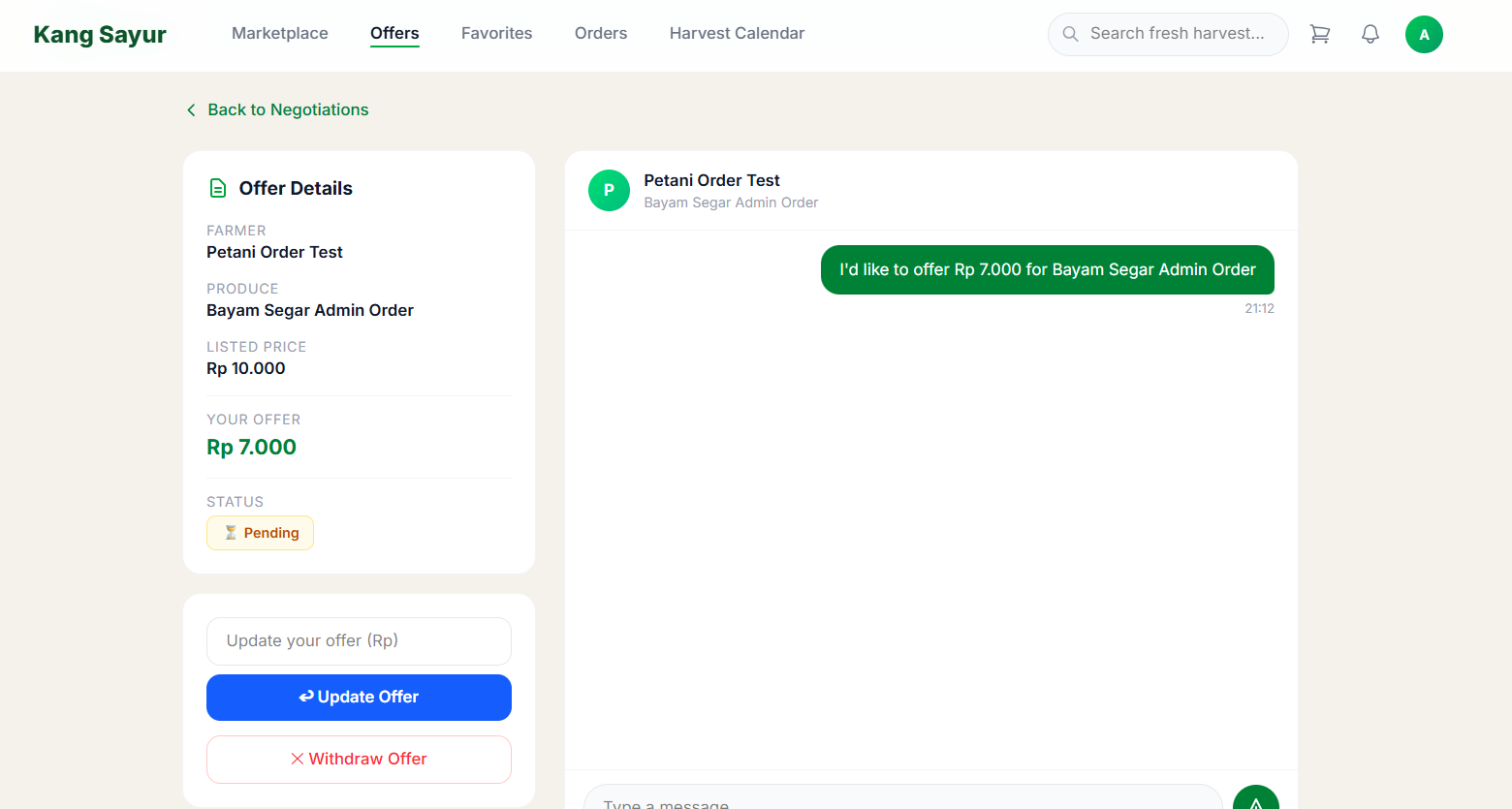
A prototype marketplace that lets farmers list and sell produce straight to customers, no distributor in between. Built as a proof of concept - not yet in production.
Full-stack MVP · not deployed
teaching myself transfer learning
A set of Jupyter notebooks working through PyTorch fundamentals - building small deep learning models from scratch, then transfer learning, which turned out to matter a lot more once I started applying models to real data.
Python · PyTorch · Jupyter
Research - p.03
Working alongside a faculty advisor, I'm building a digital twin of a real product team's sprint workflow - simulating how work actually moves through backlog, in-progress, and done using discrete-event simulation, run across Monte Carlo replications for six different sprint scenarios. On top of the twin sits a two-tier recommendation engine: a Random Forest model backed by a heuristic fallback for when the data runs thin, so it can suggest sprint decisions without pretending to be more certain than it is.
I wrote up the full reasoning behind every modeling choice in a 26-page walkthrough, and built forward-looking logging templates so the team can start feeding it real sprint data going forward.
- the honest part: the model says "I don't know" when it should, instead of guessing.
6
scenario types simulated
26
page design writeup
2-tier
RF model + heuristic fallback
Field notes - p.04
Both through community projects led by a professor I work with - plus some mentoring of my own.
helping parents manage what kids see
Helped run a workshop teaching parents how to use YouTube's parental controls and other safety settings, so families can manage kids' media access together.
from spreadsheet to story
Taught a small high school class how to turn raw data into a clear presentation - the basics of data storytelling and slide design in Canva.
matching the stack to the student
Mentoring high schoolers writing their first code. Using thunkable to create learning fun and informative.
Contact - p.05
To: you · From: Rasya Akbar Lazuardi